
Context
The aim of the capacity building subgroup is to catalyse relevant networking and training opportunities for health economists at all career stages. This initiative will complement pre-existing training opportunities, will be of direct relevance to NIHR and will be practical and feasible to deliver without major investment of resources.
The areas of skill-building, broader training and development and training include: support for fellowships, informal placements and networking, opportunities for health economists to act as Principal Investigators (PIs), support for centre leads, support for roles on NIHR panels and peer review, and providing training for non-economists. Collectively these areas will reflect the broad range of needs that health economists have at different career stages, as well as the importance to NIHR of having access to a visible, connected and highly-skilled health economics workforce.
Sub-group session - launch event
The capacity building session was convened by Richard Grieve (London School of Hygiene and Tropical Medicine), Stavros Petrou (University of Oxford) and Hannah Bromley (The Christie NHS Foundation Trust).
The session brought together about 80 colleagues across the UK Health Economics community to discuss key priorities for capacity building and collaborative opportunities.
The session was structured into nine small group discussions addressing needs in seven linked areas:
- skills development and training
- building capacity for non-economist collaborators and stakeholders
- fellowships and career development
- informal placements and networking
- opportunities for health economists to act as Principal Investigators (PIs)
- support for centre leads
- access to NIHR panel experience.
Participants highlighted gaps in:
- advanced methods training
- practical modelling skills
- PI and leadership development
- the need for clearer guidance on data access, grant writing and communication.
The group identified opportunities to enhance support for non-economists through curated online resources, toolkits and short introductory workshops.
Barriers to fellowship applications were widely recognised, particularly around protected time, access to mentoring, and institutional constraints. Delegates also emphasised the value of informal placements, structured networking, and clearer pathways for health economists seeking to lead funding applications as PIs.
Centre leads noted shared challenges around staffing, financial structures and workload, underscoring the need for peer support.
Finally, the discussion highlighted limited opportunities for early career researchers to gain grant reviewing experience and the potential value of shadowing and observation schemes to build capacity for health economists to contribute to NIHR panels.
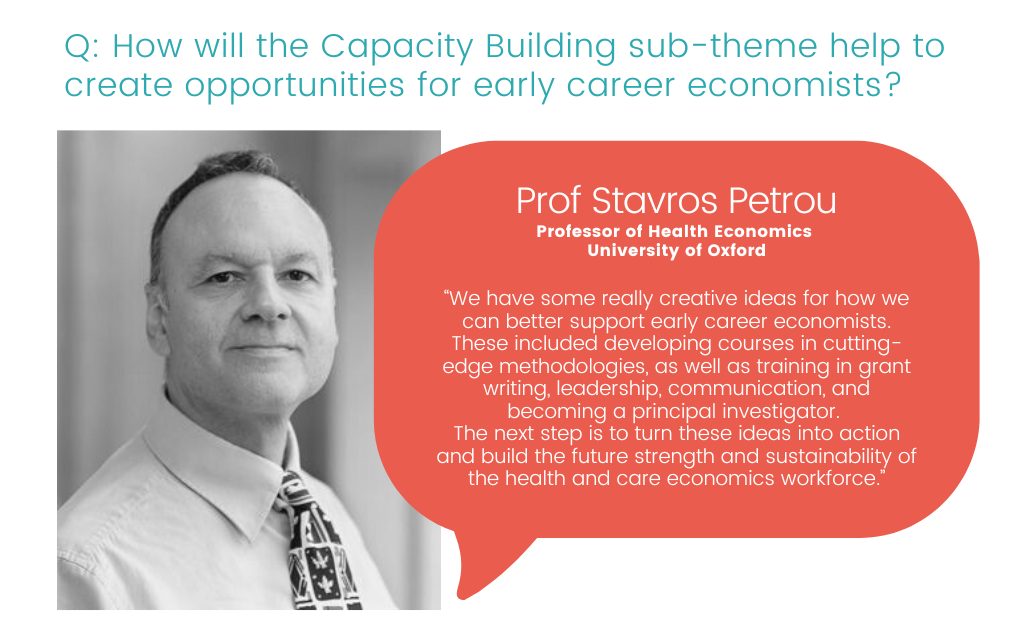
At the launch, co-lead Stavros Petrou gave his thoughts on how the Capacity Building sub-group will help generate opportunities for early career economists.
Future plans
The capacity building sub-group will be led by Richard Grieve, London School of Hygiene and Tropical Medicine, Stavros Petrou, Oxford University and Hannah Bromley, The Christie NHS Foundation Trust.
We have formed a committee comprising representatives at different stages from health economics centres across the United Kingdom:
- Committee members and focus
Skills development and training:
- Luke Munford, University of Manchester
- Adam Wagner, University of East Anglia
- Stephen O’Neill, London School of Hygiene and Tropical Medicine
- Iris Mosweu, London School of Hygiene and Tropical Medicine
- Cath Harris, University of Lancashire
Capacity building for non-economists:
- Sean Gavan, University of Manchester
- Xingna Zhang, University of Liverpool
- Ekaterina Bordea, University College London
Fellowships and career development:
- Katie Spencer, University of Leeds
- Manuel Gomes, University College London
Networking and placements:
- Emma Frew, University of Birmingham
- Angela Bate, University of Northumbria
Health Economists as PIs:
- Hareth Al-Janabi, University of Birmingham
- Rowena Jacobs, University of York
Centre leads:
- Matt Sutton, University of Manchester
- Mark Sculphur, University of York
Health Economists on NIHR panels:
- Olivia Wu, University of Glasgow
- Katherine Payne, University of Manchester
Wider Capacity building needs:
- Nils Gutacker, University of York
The capacity building sub-group will coordinate work to develop a coherent programme of support for health economists within NIHR.
Initial priorities include:
- mapping existing training
- developing a central resource repository
- identifying where new provision is required.
Future plans include:
- improving fellowship support through enhanced mentoring and better signposting
- expanding training and materials for non-economists
- exploring options for informal placements, networking opportunities and meet-and-connect events.
The group will also take forward work to clarify routes for health economists to become PIs, provide peer support for centre leads, and liaise with NIHR on opportunities for panel shadowing and reviewer development.
Regular updates will be shared through NIHR Economics Group communication channels as the programme develops. We will develop a programme of training and development with options for delivery that include ‘short courses’ prior to an annual NIHR economists meeting, and webinars on designated topics.
 Prof Richard Grieve
 Prof Stavros Petrou
 Dr Hannah Bromley