Context
Public health policies and interventions are typically complex, covering a spectrum from 'medical' interventions, like vaccination programmes, through interventions that act on individual behaviour and risk factors, community-based interventions and up to environmental interventions such as reducing air pollution or improving access to green and blue spaces.
This diversity and complexity lead to challenges for the design of economic evaluations which are essential for informed policy decisions.
Sub-group session - launch event
The session was convened by Helen Mason, Rachel Baker (Glasgow Caledonian University) and Heather Brown (Lancaster University).
The aim of the session was to provide a brief introduction to public health interventions and then, drawing on examples from projects funded by NIHR, to highlight the challenges we have faced and the approaches we have taken to produce useful economic evaluations.
The session ended with a discussion on how to develop the economic evaluation methods toolbox to support the evaluation of public health interventions.
Challenges covered in the session included:
- Complexity relating to interventions that respond to need – so vary between people – and change over time as participants develop strengths.
- Interventions that already exist and are not introduced into a system meaning that experimental designs are not available/practical/ethical.
- Interventions that are designed to build and then maintain wellbeing. If people are already engaged and continue to be well and better able to cope with shocks, any comparative study (before/ after; control group) will detect no impact in these groups, even though experts and participants report huge changes and the importance of supporting people to maintain health and wellbeing.
- Establishing the effectiveness of policies and interventions that include external confounding factors such as political and economic factors, multiple and interacting components in policy, variations in implementation, and lag in effects in health and spillovers to non-participants. This leads to challenges in assessing attribution, access to granular and/or linked data, health economic methodological tools and outcomes which are designed for RCTs and assessing medical technology and pharmaceuticals.
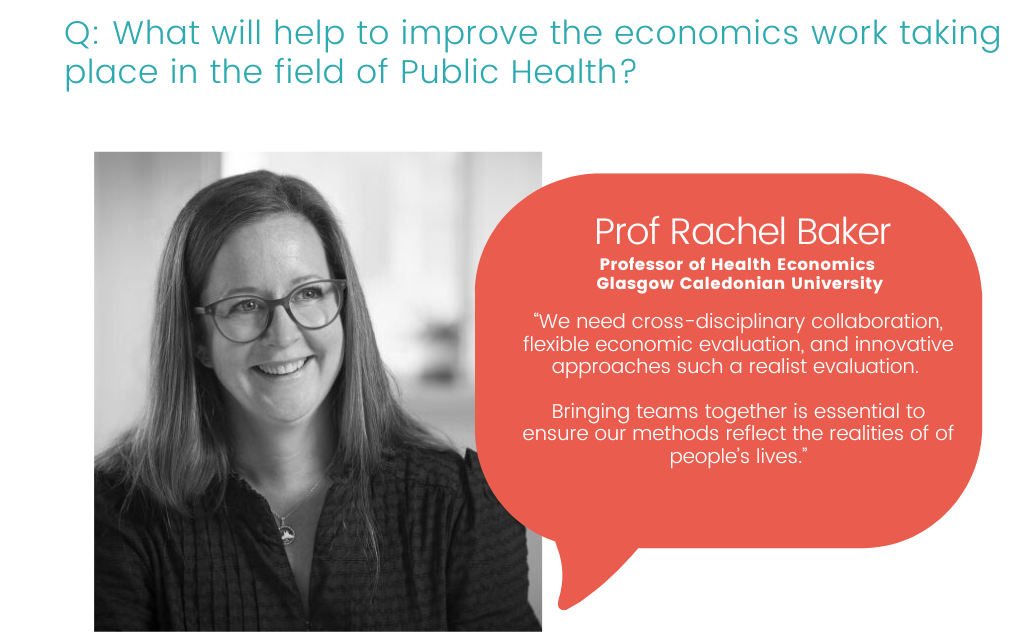
We asked Public Health co-lead, Prof Rachel Baker, her thoughts on the most important elements needed to improve Public Health economics.
Future plans
The sub-group will be co-led by Helen Mason and Rachel Baker (both from Glasgow Caledonian University).
There was interest in having methodological seminars or workshops focussing on specific challenges within economic evaluations of public health interventions, such as choice of outcome measures or development of counterfactuals and comparator groups.
All participants at the Public Health Session will be contacted to gather interest in developing a seminar or workshop programme in the new year.