Context
Mental health economics focuses on understanding the causes, consequences, and costs of mental ill health, and on identifying how to allocate resources effectively across prevention, treatment, and long-term support. Mental health presents unique economic challenges due to high prevalence, substantial societal burden, inequalities in access and outcomes, high comorbidity with physical health, and complex care pathways.
Sub-group session - launch event
The session was convened by Rachael Hunter (UCL), Rowena Jacobs (University of York) and Rachel Elliott (University of Manchester), .
The aims of the session were to:
- Bring together researchers interested in mental health and care economics to share ideas, experience, and build collaborations.
- Explore methodological challenges unique to mental health and care economic research.
- Consider how a community of practice could advance capabilities, connect people and projects, and support future funding applications.
The session started with a presentation by Rowena, where she talked about what makes mental health economically distinctive and where economists can contribute: modelling demand and supply, valuing mental health, addressing evaluation challenges, and considering wider system impacts.
This was followed by three case studies addressing methodological challenges:
- Whole-Disease Modelling for Schizophrenia (Huajie Jin, KCL)
- Target Trials for Digital Mental Health (Matthew Franklin, Sheffield)
- Economic Evaluations of Self-Harm and Suicide Prevention (Fanyi Su, Manchester)
This was followed by a group discussion where participants explored how a community of practice could:
- strengthen methodological expertise
- link researchers and existing initiatives
- support collaborative projects
- enhance capacity for early-career researchers
- define NIHR’s role
- complement existing groups (e.g., IHEA SIG)
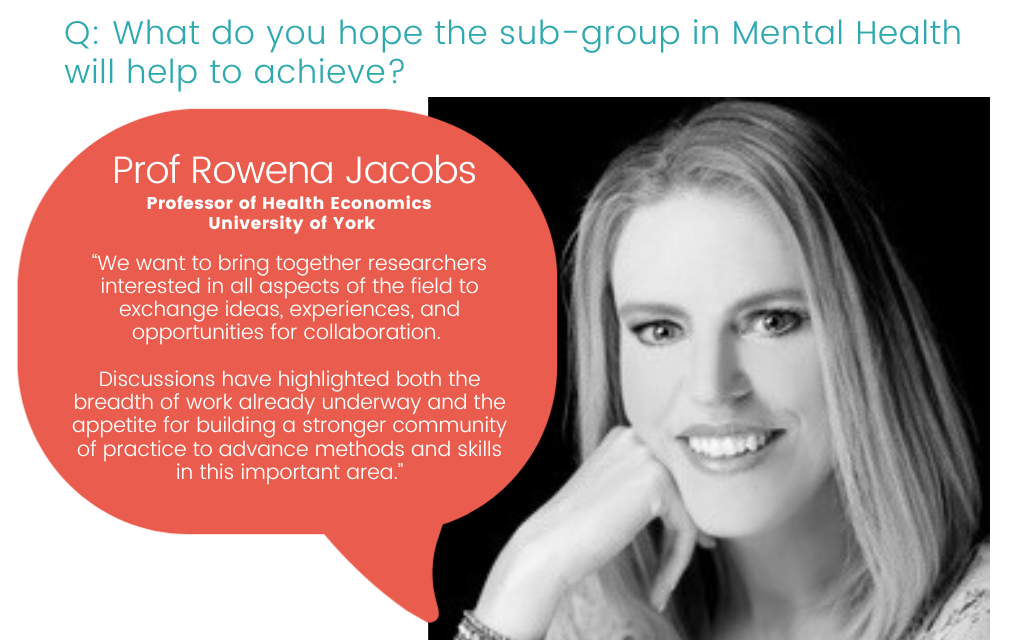
We asked Prof Rowena Jacobs, co-lead of the sub-group, what she hopes having a Mental Health sub-group in the NIHR Economics Group will help to achieve.
Future plans
In the longer term, we hope a community of practice will evolve that might involve seminars and a forum for sharing ideas and opportunities for collaborations to form to undertake research in this area. This initiative is co-led by Rachael Hunter and Rowena Jacobs.
Essentially, our future aims are as follows:
Methodological Development:
- Expand use of linked real-world datasets.
- Improve modelling of complex and long-term mental
health trajectories. - Advance causal inference and approaches for non-randomised
evidence. - Capture wider societal impacts (employment, education, justice).
Collaboration and Capacity Building:
- Establish a UK community of practice for mental health economics.
- Build cross-university, clinical, policy, and NIHR networks.
- Provide structured support for ECRs and new PIs.