Context
The Economics in the Policy Research Programme (PRP) sub-group focuses on Policy Research Units (PRUs), the PRP more generally and specific themes in relation to the policy research.
We asked sub-group lead, Prof Mark Sculpher, to tell us more about PRUs. 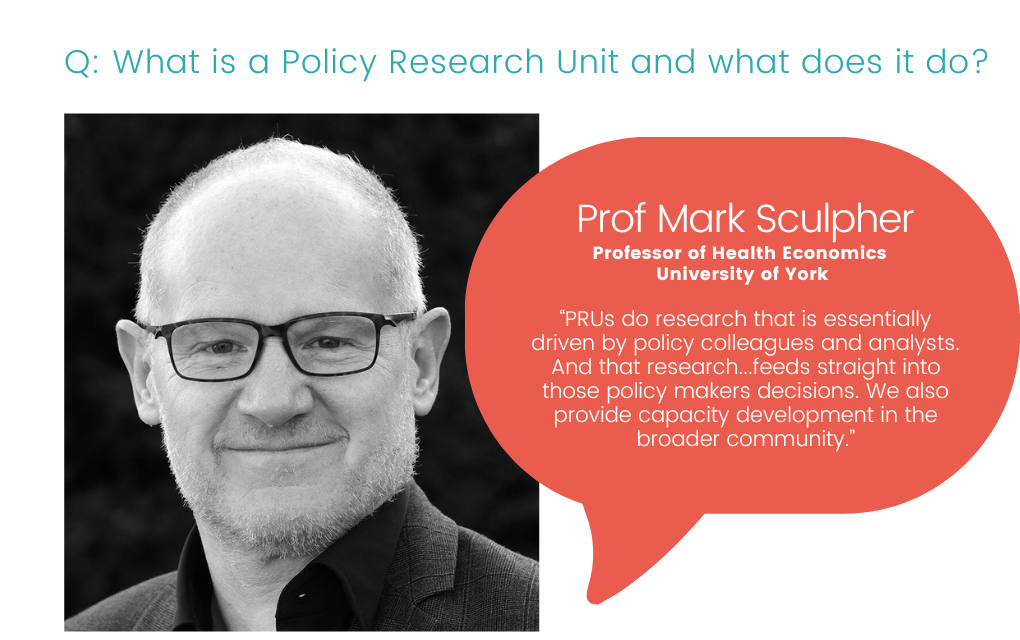
Sub-group session - launch event
The Economics in the PRP sub-group covers a big area, so the session was split into 5 separate topics.
- How to draw up PRU projects
- How to juggle reactive work with short turn-arounds and more longstanding PRU work
- How to find an academic angle to reactive work, and how to keep a research theme/strand going through all PRU projects. For example, if DoHSC is interested in maternal/neonatal inequalities, and then in another project birth trauma, trying to keep the inequalities component as a running thread.
- When designing a project, how to convey that these had to be feasible within the time frames and resources available. Also how to refocus a project when the DoHSC/NHS do not appear to know what they need/want bar a general outline.
- How to incorporate research capacity within a PRU, and how working in a PRU might be a great opportunity for junior researchers as it gives them a direct line to policy makers and a direct route to some form of impact. We also discussed ways to incorporate some PRU work in DRFs or Advanced Fellowships, given their direct route to policy makers and therefore to impact (so important with NIHRs focus on demonstrable patient benefit).
- Policy Research Programme and PPI
- We discussed terminology, having a glossary of terms would be helpful
- Capacity building of researchers in PPIE (role for NIHR?)
- The fact that for methodological work it is more challenging to engage PPIE
- Managing the ‘professional patient’ as part of the process
- Getting representative populations / voices
- How to evaluate impact of PPIE
- How to identify networks / charities (PRUs can help)
- Different payments (rates) of PPIE for NIHR vs charities vs NHS Trusts
- PRP fundings calls
- PRP funds policy research to enable evidence-informed policy making in health and social care.
- All of the calls are responding to policy needs, there are no researcher-led opportunities
- They prioritise relevant, timely, accessible evidence, and they like regular reporting throughout a project.
- The panel comprises a mixed group of academics - including several health economists - and PPI members. Also policy makers, liaison officers and analysts attend. In the discussions, we hear first from policy, to hear whether they think the application would meet their needs. They don't score the applications, but provide important context. All other members score (including two PPI members for each application)
- As with other areas of NIHR, PPI, EDI and research inclusion are essential.
- Implications of this for applications: make sure policy relevance is clear, that you have good plans for reporting to policy makers, that your application is clear for a mixed panel and that PPI is good.
- We looked at some open calls and recent decisions (e.g. the work and health research initiative, evaluation of the fair pay agreement in adult social care, understanding disparities in the use of medical devices in pregnancy and neonatal care).
- PRP provides a direct line to policy, which is motivating and good for research impact
- Health economists can (and do) lead projects, but usually with a multidisciplinary team.
- For some large topics (e.g. work and health, preparing the NHS for resilience to climate change) there are opportunities for seed funding - £100,000 to create teams and develop plans for a larger grant.
- The panel is being refreshed - there was a recent call for expressions of interest from potential members, and the panel chair will soon be advertised.
- On achieving research impact
- Sharing session across PRUs (and wider) on good examples, innovative approaches
- Potential for policy customers to participate and say what they need to see.
- Rapid turnover of "customer" staff was an issue.
- The importance of topic selection balancing current needs with higher risk work anticipating future needs. Some examples of this from policy makers would be helpful.
- On capacity building
- Options for health economists outside PRUs to get involved with PRU work, perhaps aided in the first instance by a better way of knowing what work goes on in the PRUs.
- There was recognition that responsive mode work is both challenging and ‘exciting’. The challenges come from diverting people away from longer-term projects, including those that might make the most obvious strong contributions to the development, including preparation of high-quality publications of a kind that are needed for career advancement within universities.
- On the other hand, responsive mode work brings the researcher closer to the policy customer, and increases the chances of impact, as well as reinforcing the policy relevance of the work that is being undertaken.
- It would be good if there was an opportunity to collaborate across PRUs – or across NIHR more generally, to make it easier to respond to responsive requests in a timely fashion and with the right expertise.
- It can be hard for ECRs (or even MCRs) to know how best to respond to responsive mode requests – there is a need for involvement of more senior colleagues.
- Some responsive mode requests can be helpful in taking the researcher/team into new territory, opening up new research opportunities. On the other hand, some requests are for somewhat prosaic types of work.
Future plans
Further discussion is needed but possible future directions include:
- supporting coordination between economist in PRUs
- capacity development in achieving policy impact in health economics
- writing policy-relevant research grants.