Context
The NIHR has funded 15 Applied Research Collaborations (ARCs) across England to undertake high-quality applied research with a focus on generalisable learning at a regional and national level. Working closely with stakeholders including the Integrated Care Systems (ICSs), the Health Innovation Networks (HINs) and other NIHR infrastructure, the ARCs also support knowledge mobilisation and implementation of research-based evidence to ensure effective interventions and models of care can be scaled nationally thereby maximising the impact of research.
The key goals of the ARCs are to:
- create an environment for the conduct of high quality, generalisable applied health, public health and social care research
- use knowledge mobilisation approaches to support an increase in the rate at which research findings are implemented into practice at scale
- address health inequalities by embedding inclusive approaches across all projects and programmes
- increase the country’s capacity and capability
- collaborate to respond to national health and care challenges
- contribute to broader economic gain.
A second cycle of NIHR funding to support ARCs will commence in April 2026.
Economists have been embedded within the work of each of the ARCs since their establishment, but with different modes of working and research focus. They are contributing to, and often leading, assessments of the cost-effectiveness and economic value of new interventions or services; and studies of the behaviour of individuals, health and care providers, and health and care systems. Increasingly, economists are embedded within commissioning processes and working with commissioners to apply economic principles when allocating health and care resources.
There have been attempts in recent years to create and support a network of economists working across the ARCs. We hope to strengthen and consolidate those attempts during the second cycle of ARCs (ARC2).
Sub-group session - launch event
This session was convened by Stavros Petrou (University of Oxford) and Matt Sutton (University of Manchester).
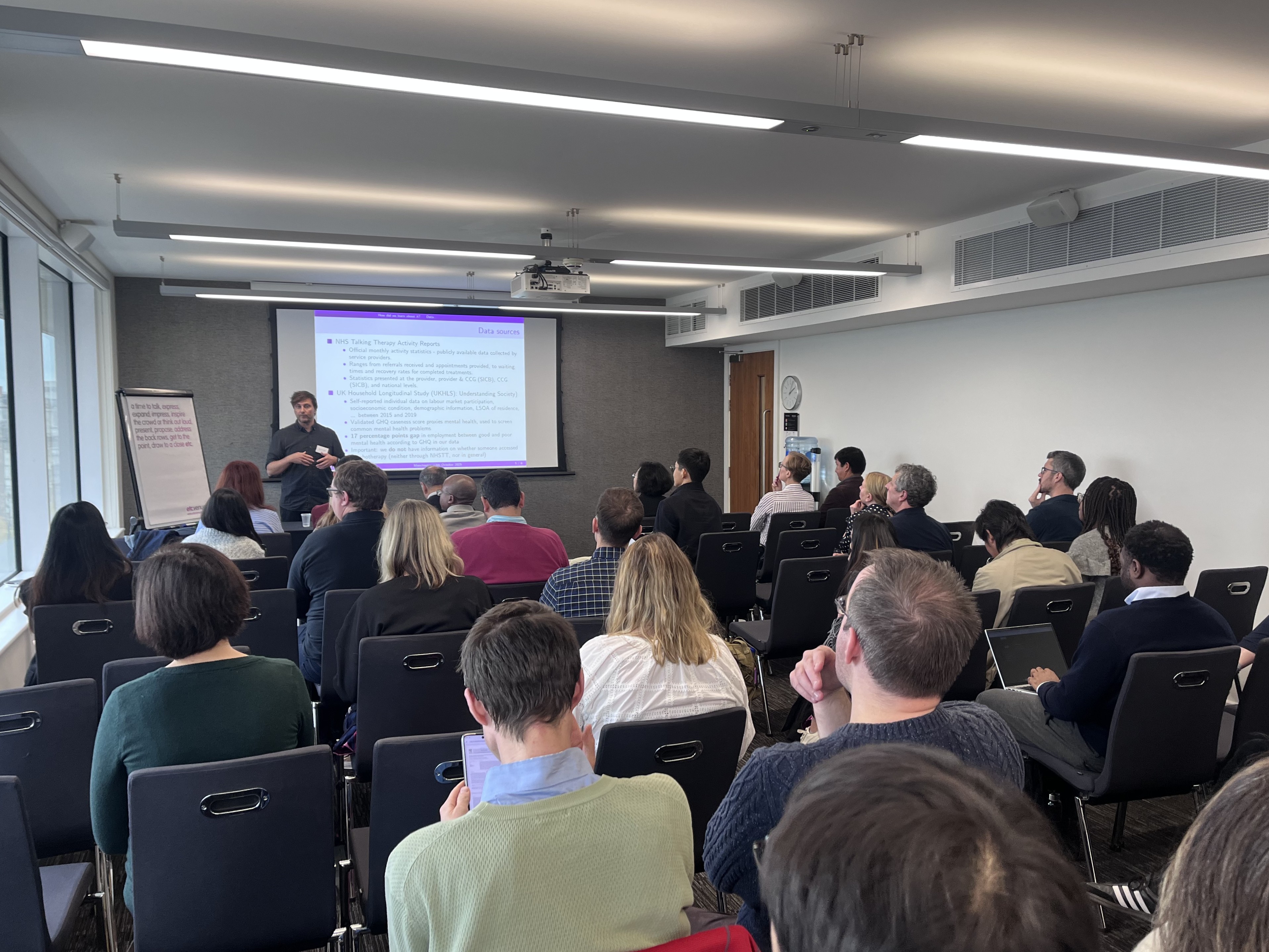
The aim of this session was to showcase economic research studies funded during the first cycle of ARC funding (covering the period 2019-2026). We showcased completed (or close to completed) research studies with evidence of close working with stakeholders and clear pathways to impact. The session particularly highlighted the role that economists have played in responding to and meeting the priority research needs of the health and care system and the population, with a focus on generalisable learning at a regional and national level.
The session centred on the following presentations:
- Igor Francetic (University of Manchester)
The effect of area-level waiting times for psychological therapies on individual-level
labour market outcomes - Valerio Benedetto & Misael Anaya Montes (University of Lancashire):
Exploring alternative ways to measure cost-effectiveness: a mixed-methods
programme of work in the ARC Northwest Coast - Michela Tinelli (London School of Economics):
Advancing data-driven approaches to homelessness through dynamic monitoring,
evaluation and economic impact - Dacheng Huo (University of York): Modelling the case for cost-effectiveness of
interventions to improve medication adherence in patients with difficult to control asthma - Ni Gao (University of York): Home Sweet Home: What is the role of housing
quality on the relationship between cold weather and emergency admission?
Future plans
This sub-group is currently led by Stavros Petrou (University of Oxford) and Matt Sutton (University of Manchester). However, we are keen to receive expressions of interest from economists working in ARCs to join a committee to take the NIHR ARC sub-group forward. We are keen to ensure representation from across England.
Once the committee is formed, we plan to develop a directory of economists working in the ARCs. We also plan to circulate a brief questionnaire to those economists to further understand how we might: support them moving forwards, and identify future opportunities for providing advice and training, ensuring consistency, maintaining standards and progressing methodology.